How to build a wedding guest list (without family drama)
A practical method for building your wedding guest list, handling plus-ones, and saying no to people without burning bridges.
The short version:
- Start with everyone, cut ruthlessly. The first list is always too long.
- The “we’ll just send a B-list invite” plan almost never works. Don’t bank on it.
- Plus-one rules apply to everyone or no one. Half-rules cause the most resentment.
There are two phases to a wedding guest list. The first phase is when you and your partner write down every name you can think of. The second is when reality sets in. The venue holds 120, your budget is $35K, your parents sent over 47 names you’ve never heard of, and you have 90 days to make this work.
Here’s how to actually get to a guest list you can live with — without spending six weeks fighting with your future mother-in-law.
Start with the everything draft
The first version of your guest list shouldn’t be filtered. Sit down with your partner, open a shared doc, and write down every person you’d want at your wedding if there were no constraints. Friends, family, work people, the friend you haven’t seen in five years but who’d cry if they weren’t invited.
This list will be too big. That’s the point. You can’t make smart cuts from a list that was already pre-cut by anxiety.
Common mistake: starting from the venue capacity and working backward. That makes every name feel like a battle. Start from “everyone we’d want,” then negotiate down.
The capacity reality
Once you have the everything-draft, get three numbers in front of you.
- Venue capacity. The number the venue actually allows, not the marketing number. Ask explicitly: “what’s the most we can seat with the bar setup we want?”
- Catering budget. Cost per head × your headcount can’t exceed your food budget. This is usually the hardest cap.
- Realistic RSVPs. Plan for 80–90% of invited guests to actually show up. Out-of-town weddings drop closer to 65%. Don’t trim down to capacity — trim down to capacity ÷ 0.85.
Most couples ignore #3 and end up either turning people away or having half-empty tables. The 85% rule is the fastest way to right-size your invite list.
The B-list myth
You’ll hear advice about sending an “A-list” invitation 8 weeks out, then a “B-list” invitation 4 weeks out to fill the seats freed up by declines.
It almost never works. Here’s why.
- Most people RSVP late. By the time you know who’s declining, your B-list invite arrives so close to the wedding that the recipient knows they’re a B-list invite. Resentment, not gratitude.
- Save-the-dates compound the problem. If you sent a save-the-date 6 months out, B-listers feel especially second-class.
- The administrative overhead is brutal. You’re tracking two invite waves, two RSVP deadlines, two seating maps.
Better approach: cut hard at A-list and live with whatever final number you get. If 15 people decline, you save money — that’s fine. Empty seats are not the problem you think they are.
The plus-one rules that actually work
This is where most lists fall apart. Here are three honest plus-one rules. Pick one and stick to it.
Rule A: Plus-ones for cohabiting couples only. Living together (or married/engaged) → plus-one. Dating but not living together → no plus-one. This is the most-used rule and the easiest to defend. The line is clear and not arbitrary.
Rule B: Plus-ones for serious relationships, defined as 1+ year. This is fairer to long-distance couples but harder to enforce because you’re now in the position of judging “serious.” Expect some conversations.
Rule C: Everyone gets a plus-one. The simplest rule, the most expensive. Adds 30–50% to your guest count. Worth it for some weddings, ruinous for others.
The rule that almost always causes drama is “plus-ones for some, not others.” People talk. The cousin who got a plus-one for their two-month boyfriend will be at the same table as the one who didn’t get a plus-one for their 18-month relationship. You’ll hear about it.
Handling parental “must-invites”
Your parents sent you a list of 30 people you don’t recognize. Half are family friends from before you were born. Some are clients. A few are people who invited them to weddings 25 years ago and now expect reciprocation.
You have two options.
Option 1: Give your parents a budget. “Mom, you can invite 15 people from your side, and Dad can invite 15. You decide who. We can’t go over 30 between you both.” This puts the political work on them, where it belongs.
Option 2: Match the contribution. If your parents are paying significantly, expect 15–25% of your guest list to be theirs. If they’re not paying, you set the rules. The classic “you must invite my second cousin” battle becomes much shorter when the answer is “we appreciate the input — our budget doesn’t allow for guests we haven’t met.”
Whichever you pick, make the rule before the list, not after.
The cuts you’ll second-guess (and shouldn’t)
Three cuts feel cruel and almost always turn out to be fine.
- Coworkers you don’t see outside work. They’re rarely offended; they often feel relieved. If you’re worried, say something casual the day after the invites mail: “I wish we could’ve invited everyone — venue capacity is brutal.”
- Friends from previous chapters of your life. The college friend you haven’t spoken to in three years isn’t expecting an invite. If they were, they’d have stayed in touch.
- Kids you don’t actually know. The “and family” instinct expands the list fast. Inviting only kids you have real relationships with is normal. Plus, child-free weddings are increasingly common — nobody will be shocked.
The only cut that will sting: friends or family who are expecting an invite. Cut them, and follow up with a short note. “You’re really important to me. We had to keep our wedding small. I’d love to take you to dinner and tell you about it.” It’s awkward for an hour and forgotten by the next year.
Tracking the list as it changes
Your list will change ten times before it’s final. Use a tool that handles versioning, not a Google Sheet your partner forgets to update.
The minimum your tracker needs.
- Name, partner/plus-one if applicable
- RSVP status (invited, declined, attending)
- Meal preference / dietary
- Side (yours, partner’s, parents’ — for budget tracking)
- Address (for save-the-dates and invitations)
- Group (immediate family, wedding party, college, work, parents’ friends)
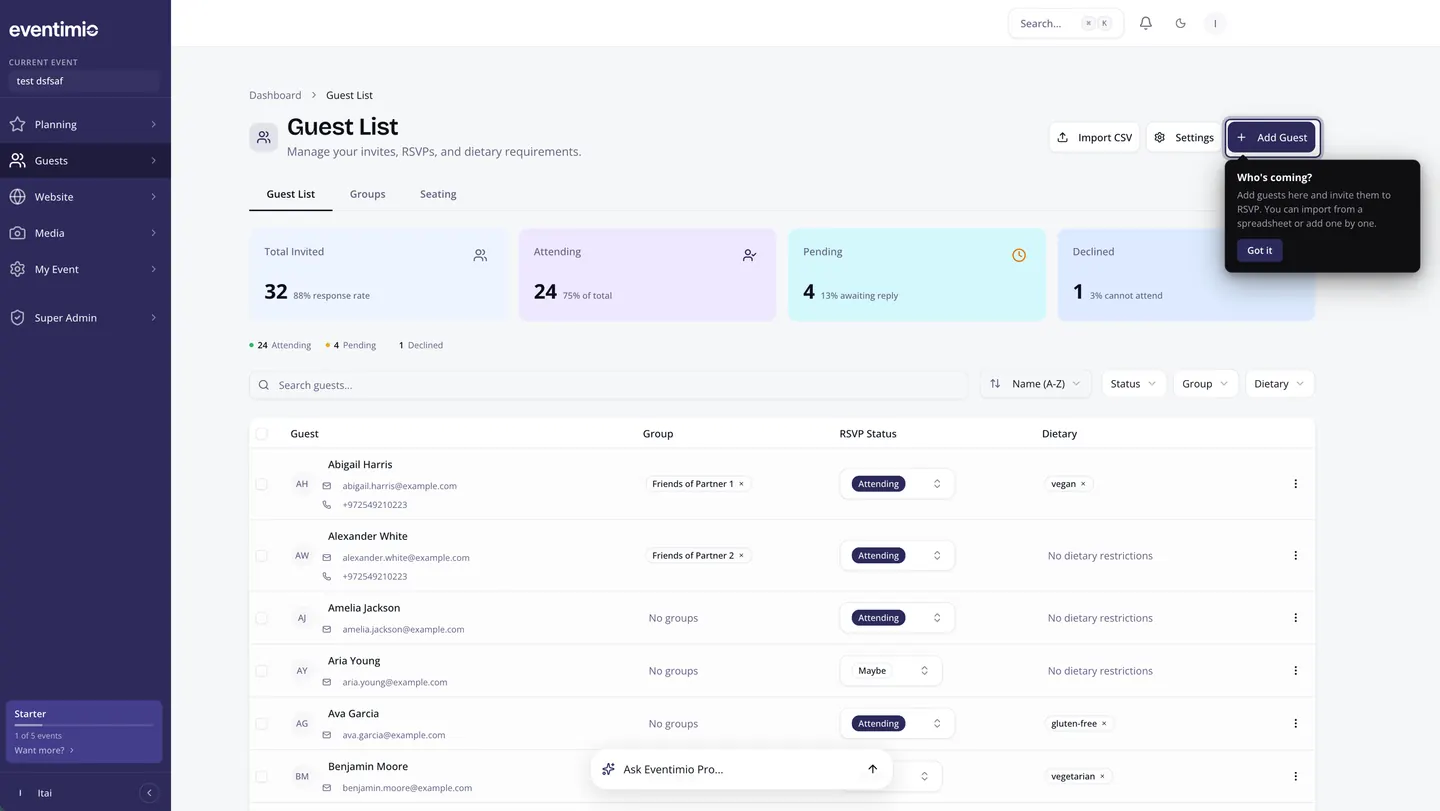
If you’re using Eventimio for guest management, this is built in. The same list flows from “invited” through RSVP, dietary, seating chart, and into the post-wedding thank-you tracker. No spreadsheet drift.
What to do once the list is final
You’re not done. The list keeps moving until the wedding day.
- 2 weeks after invites mail: Start tracking RSVPs. Late RSVPs are a real thing. (Here’s the full RSVP timeline.)
- 4 weeks before the wedding: Final headcount goes to the caterer. Make sure dietary restrictions go with it. (Dietary management guide.)
- 2 weeks before: Lock the seating chart. People will RSVP late and you’ll need to slot them in.
- Day before: Re-confirm with your wedding planner. Late changes always happen.
The truth about guest list regret
Almost no couple regrets cutting their guest list shorter. Many regret cutting it too generously and ending up with people they barely know at the most important day of their life.
Trust the cut. Smaller weddings are better weddings.
Tracking 150+ guests with no spreadsheet? See how Eventimio handles guest management. Invitations, RSVPs, dietary, seating, and thank-yous in one place.